Tuesday, January 15, 2013

Final preparation before integration week


 After a long and well deserved Christmas break the team is once again in place and working on the experiment. The experiment is fully functional and is mostly verified. So one might expect that we could lean back and enjoy our wonderful work now, but there's a lot more to be done before we can ship our experiment to Bremen in the end of January.
 
Some of our main points are:
 
  • Create the box for shipping the experiment
  • Do vibration test with new PCB's
  • Prepare the rocket module with covers over the venting holes
  • Produce multiple sets of soldering setups for integration week
  • Do multiple end to end test with complete system
  • Make PCB's flight ready
  • Implement temperature monitoring of battery packs during charging
  • Implement the sd-backup system
So understandably the team will have to work at full speed for the following two weeks. We are however confident that all the major points will be sorted once it is time to ship everything.

Once the experiment has been sent to Bremen we will send down two team members both named Björn. They are experts on the electrical and software system in SOLAR and could hopefully resolve and issues we could have during integration.
The integration week is pretty much what it sounds like, our experiment will be integrated with the other experiments and the rocket service module to make sure all the interface between different parts of the rocket works as expected.

If we have no major faults in our design the experiment will remain in Bremen before being sent to Oberpfaffenhofen outside Munich. There it will undergo a series of test to verify the flight readiness of our experiment.

So that's what we're working towards right now.
We'll try to get another update out sometime during this week, if not on the blog at least on our facebook page.

Have a nice day :)


Tuesday, November 20, 2012

EAR

So yesterday we had our EAR (Experiment Acceptance Review) and we welcomed Mikael Inga and Alex Kinnaird back to Kiruna! We started off by presenting the updated and improved parts since the IPR and also our last steps before we can send the experiment to Germany for testing. After that we had a demonstration of the actual experiment where we melted six samples and explained the course of events during the flight. We were very happy with both the presentation and demonstration and we hope Mikael and Alex felt the same way :)

Whats left to do for the team right now is to improve every last detail and solve the last minor issues. We will also focus on writing detailed checklists for launch campaign so that we are fully prepared!

We would also like to congratulate the teams on REXUS-11 for the successful launch campaign that took place last week! We are kinda jealous but we hope to join the club in May next year! :D 

ps. check out our team t-shirts!

 The rocket module was tried out and voila, fits like a glove!
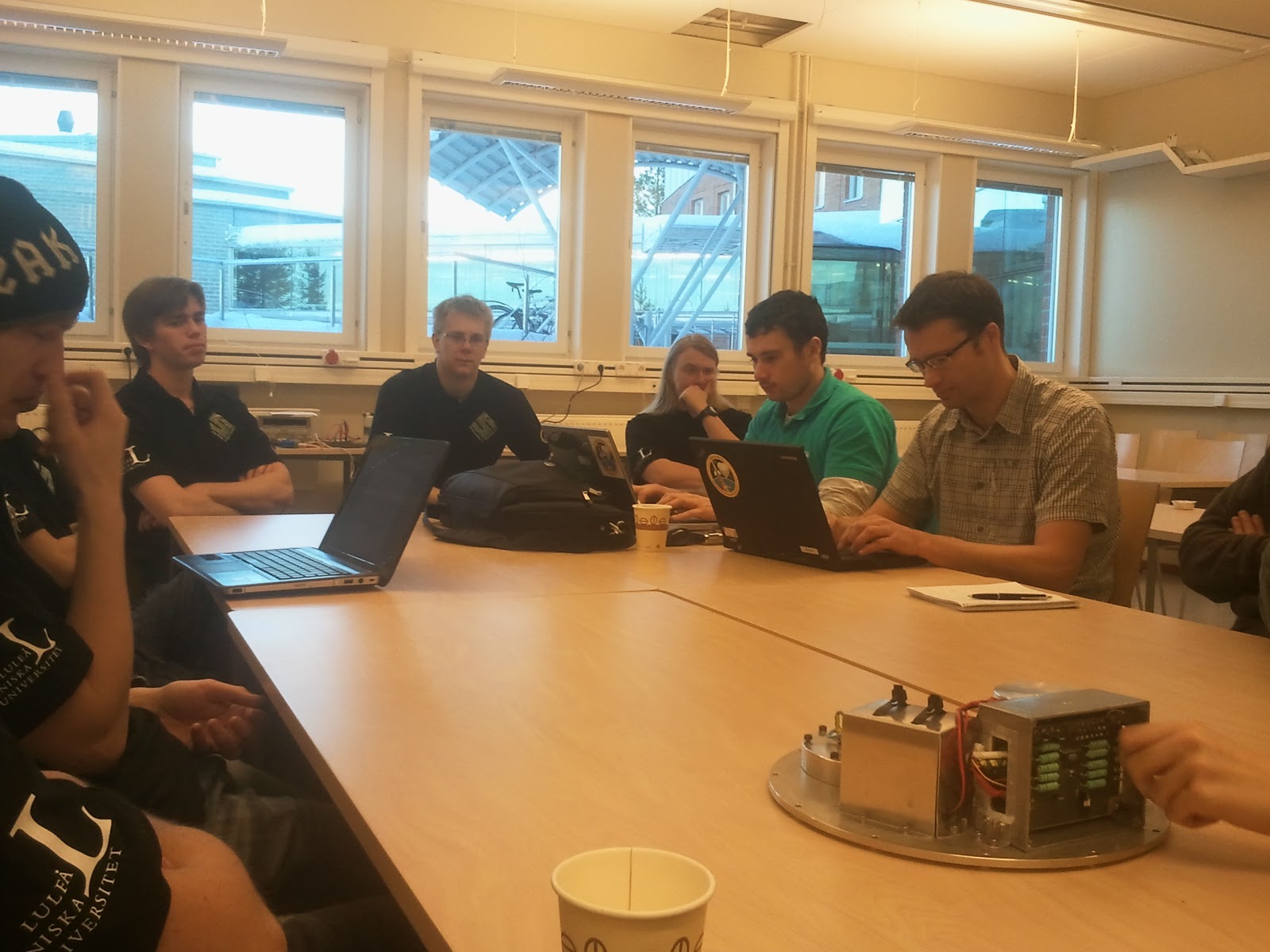
 Discussion and time for questions


 Maja and Johanna are admiring the experiment


 The experiment mounted on the bulk head with the candy-looking
power resistors in the electronics box.


Saturday, November 17, 2012

Today another saturday is spent in the school for the team members living in Kiruna. Todays tasks are to make the last minor adjustments, make the final assembly and perform the final vacuum and thermal tests.

Except that, all preparations have to be made for our EAR that we have at monday morning. We feel that we have got some really positive results since the IPR, hopefully Alex and Mikael will share this opinion.

Here you can see the major part of the experiment while Björn is working on the final assembly before the thermal tests.

Thursday, November 8, 2012

The story of Johanna and deadlines

After both exams and halloween celebration we are now working towards our deadline set on the 19th of November when the entire experiment shall be ready for shipping to Germany. The actual shipping will not take place until later but we want to have some time to work on last minute details and refinement.

Our first goal is the SED-submission due on monday the 12th so we figure there will be some late nights and weekend work for the team.

Our work right now is mainally to finish all soldering, PCB-manufacturing and procedure-documentation parallel with several tests. I managed to get a short interview with one of the team members, Johanna!

This is Johanna!
Johanna is working with the mechanics-team. Her work includes FEA-simulations, PCB-manufacturinga and battery insulation. She is studying towards a master in aero space engineering. Her favorite food is moose steak with potatoes and bearnaise sauce and she likes to walk around with a backpack in the forest. Her interests also includes skiing and making snow-angels.

So, Johanna, how is the work coming along?
- There are mostly refinement work left in the mechanics group and we are actually beginning to see the end!

What would you say is the best thing with Project SOLAR?
I would say that the education and team work is the best parts of the project. I learn new things all the time when it comes to project planning and engineering which I think will be a great experience in the  future.

What is the most difficult part of the project?
The communication can be quite a challenge since we have a pretty big team (14 people!)....we are all study at the same time with different schedules so the planning is hard sometimes. I´m impressed that we managed to pull it off during the entire project with meetings, deadlines etc. and there is no stopping us now!
What will you think when YOUR experiment is fired away onboard the sounding rocket?
I will be very happy of course to have actually made it to the end! I will also be very nervous about the outcome of the experiment; will something go wrong? did we forget something? what if this or that happens?
So mostly happy but a little bit nevous!


Is this Johannas life-long dream?
And how is life in the small city of Kiruna?
The surrounding nature is fantastic with the mountains and forest. The view from our school is beatiful now when there is snow on the trees and clear blue sky. The institute of space physics is right next door which is a great benefit when we have technical questions.
But I must say that there could be more people, a warmer climate and a McDonalds....then I would never leave!


Do you have any advice to those who want to start a project?Find a good group of people that you trust and that you can work with through both good and bad times. Make a good and realistic time-plan and what to do if something goes wrong. Have FUN and encourage each other.

Last question, who is your favorite team member in the group?
I would have to say Anneli, since she is so smart, funny, good-looking and a great friend!

Interview done by Anneli


Monday, October 22, 2012

First vibration test


Good evening!

Last week we performed our first vibration test, where we tested our vacuum chamber, the D-SUB holder and our electronics box with the PCB's. Dummy weights were placed on each PCB to simulate the weight of the actual components we will use. This first test was performed to see that our main structures could withstand the expected vibrations from the rocket. We also wanted to ensure that the PCB's with the dummy weights would not crack due to the vibrations (I guess that the electronics group would have gone mad if we broke their real PCB's during the "real" and final vibration test).

The test was done in four steps:

1. We made a sine sweep at 0.25g to search for eigen-frequencies.

2. We made a sinusodial test at Qualification Level i.e. at 4g.

3. We made a random vibration test at Acceptance Level i.e. at 6 grms.

4. We made an additional sine sweep at 0.25 g to compare to the first one to see if the structures had changed (different or modified eigen frequencies).

The results were good and all parts still seems to be alive. However the two graphs from the sine sweeps was not identical, but we found that one of our dummy weights almost was loose, which probably explains the unequality of the graphs.

Here is the experiment mounted on the shaker before the test


We are also happy to give you a video of the sinusodial test (2)


Unfortunately the quality was deteriorated after the transfer from my phone, but hopefully you can enjoy it anyway.

In the beginning the frequencies are low and you can see the vibrations clearly, but at the end the experiment seems to be stationary. This is due to the high frequencies (ca 2000 Hz), so actually it is oscillating extremely fast, or more exactly; ca 2000 times/sec.

Bye!


Friday, October 19, 2012

Hello!

As we promised we will give you a picture of our final layout:


This is all parts attached to our own simplified bulkhead that we use during the testing phase as we wait for the real bulkhead to be delivered.

We performed a first vibration test this week which I will tell you more about, but we save that for another post. Now I have to make some adjustments in the SED.

Ciao!

Sunday, October 14, 2012

Use copper plates, we said.. It´ll be easy, we said...

The copper plates are driving med mad!! (Mad , I tell you MAD!!)  A fairly easy part of the experiment we all assumed but manufacture these all by our selves have been a highly time consuming process. And we just COULD NOT get it right! (stop laughing! :P)  We do however believe that a working procedure have FINALLY been determined and hopefully we´ll be able to produce several approved copper plates to be used in the upcoming test phase! (Hurrah!!)

Let me guide you all through the evolution of the seemingly harmless copper plate (from hell!) :P

Copper plate v1.0 - 1.3: we went from "punched holes" (= the wavy plate) to drilled holes. To drill in a straight line was apparently much harder than predicted but we did manage to drill straight at the end, unfortunately with the holes not located were they were supposed to be!
Failure 1,2 and 3... 
And what happens when the holes are NOT EXACTLY where they are supposed to be? well, the SCREWS don´t fit as planed!
what NOT to look like... 

We figured; hmm maybe I (Maja) was not the best person to drill in these plates so Robert tried...
Robert vs. plate: 0-1
... and Johanna tried...
Johanna vs. plate: 0-2
...AND Johan tried: Johan vs. plate: 0-3
WE JUST COULD NOT WIN THIS BATTLE!!!
Failure 10, 23 and 101...
UNTIL we finally had a template that wouldn´t betray us! Secured with monkey wrenches, the copper plates are hereby looking according to plan and the experiment tests can proceed without delay! (Hallelujah!)
The Template

Behold! the screws are not in contact with each other and all copper plates now look the same
Thank You all for listening! You´ve been great!

Don´t forget to stay tune for the test phase and remember to tell your friends to like us on facebook! ;) 

Hej då!